June 5, 2026
 6 min read
Contents

|
TL;DR
|
Connex is a powerful ecommerce integration platform, especially for businesses that need complex data mapping and custom rules for QuickBooks.
But for many growing ecommerce brands, more complexity doesn’t always mean a better fit. Connex can come with a steep learning curve, higher setup costs, longer onboarding, and features many sellers may not need.
That’s why businesses are exploring simpler Connex alternatives built for accounting automation. These tools offer faster setup, easier workflows, clearer pricing, and features focused on everyday ecommerce accounting challenges.
In this guide, we’ll cover 6 Connex alternatives that help automate accounting without unnecessary complexity, so you can choose the right fit for your business.
Let’s get started!
Top Connex alternatives quick comparison
Here’s a quick comparison of the best Connex alternatives for ecommerce businesses in 2026:
|
Software |
Best For |
Key Strength |
Accounting Integrations |
Starting Price |
|
Webgility |
Multichannel ecommerce automation |
Real-time accounting + inventory sync |
QuickBooks, Xero, NetSuite |
Custom / Starts around SMB pricing |
|
QuickBooks Online |
Small businesses needing accounting-first workflows |
Native bookkeeping ecosystem |
Native QB ecosystem |
Subscription |
|
MyWorks Sync |
WooCommerce + QuickBooks users |
Two-way real-time sync |
QuickBooks Online/Desktop |
Subscription |
|
Cin7 |
Advanced inventory & B2B operations |
ERP-style inventory management |
QuickBooks, Xero |
Premium pricing |
|
Zoho Inventory |
Budget-conscious SMBs |
Affordable inventory automation |
Zoho Books, QuickBooks |
Affordable tiers |
|
Extensiv |
Warehouse & fulfillment management |
3PL and warehouse operations |
Multiple ERP/accounting tools |
Custom pricing |
Best Connex alternatives in detail
Six tools compared, so you can match the right one to the problem you're actually trying to solve:
1. Webgility: Best overall Connex alternative
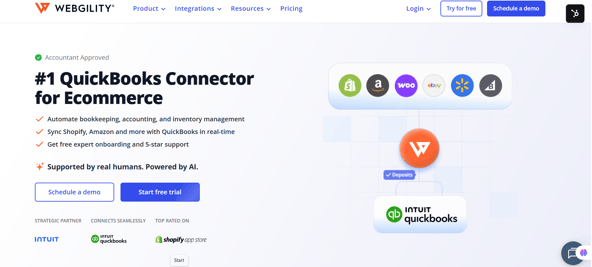
Webgility reconciles your ecommerce operations into QuickBooks and Xero, every order, every fee, every payout, every month. Where Connex moves data from your channels into your accounting system, Webgility validates that what arrived is correct, classifies it at the transaction level, and certifies the close every month. The output isn't a sync. It's always-reconciled books.
Key Features:
- Every order posted to QuickBooks or Xero with full line-item detail: revenue, fees, taxes, refunds, and shipping, not as a lump-sum deposit
- Every payout reconciled against the orders and fees inside it: Amazon settlements, Shopify payouts, and eBay releases matched automatically
- Two-way inventory sync across every connected channel, updated with every order, return, and fulfillment event
- Deep QuickBooks integration for both QB Online and Desktop, with correct transaction types for DTC, wholesale, and marketplace orders
- POS integration with Shopify POS, Square, Lightspeed, and Clover
- A named Webgility specialist certifies the close every month
Best For
Growing multichannel ecommerce brands selling on two or more channels who need unified accounting automation, inventory visibility, and operational reporting.
Limitations
May be more advanced than necessary for very small single-channel businesses.
Pricing
Starts at $19/month (billed annually).
2. QuickBooks Online
For businesses whose primary need is accounting software and whose ecommerce integration requirements are relatively straightforward; QuickBooks Online (QBO) itself, paired with its app marketplace, can replicate much of what Connex currently does.
Key Features
- Built-in bank feeds, invoicing, expense tracking, payroll, and tax preparation in a single cloud-based platform
- Automated sales tax calculation across multiple jurisdictions, including support for Avalara and TaxJar integrations
- Financial dashboards, P&L reports, and cash flow forecasting out of the box
- Multi-user access with role-based permissions, ideal for bookkeepers and accountants working remotely
Best For
Small businesses that primarily need accounting software and want to use QuickBooks' native integrations or lightweight third-party connectors for ecommerce sync. Ideal for single-channel sellers with lower order volumes.
Limitations
QuickBooks Online is an accounting platform first, not a dedicated ecommerce operations tool.
While higher-tier plans include basic inventory tracking and the app marketplace offers ecommerce connectors, QBO does not provide a native multichannel operations dashboard, advanced order routing, marketplace payout reconciliation, or ecommerce-specific inventory workflows. Sellers managing multiple channels will typically need third-party tools to fill those gaps.
Pricing
Starts at $38/month (Simple Start). Plus plan (which includes inventory tracking) starts at $158/month.
3. MyWorks Sync
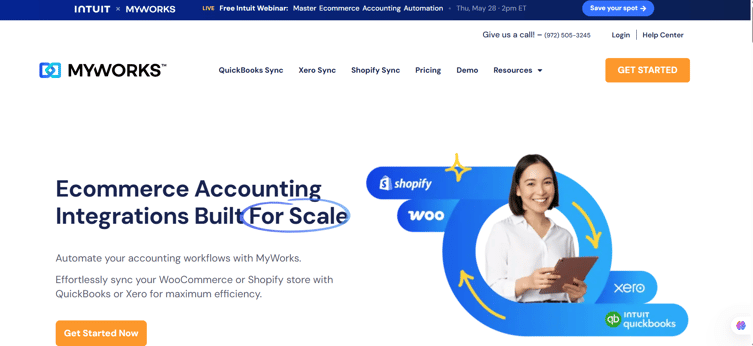
MyWorks Sync is another focused connector built specifically for WooCommerce-to-QuickBooks sync. If your entire ecommerce operation runs through WordPress and WooCommerce, and your primary need is keeping QuickBooks in sync without manual data entry, MyWorks delivers a clean solution.
Key Features
- Real-time two-way sync between WooCommerce and QuickBooks Online or Desktop: orders, customers, products, and payments
- Granular field-level mapping for order statuses, payment methods, tax rates, coupons, shipping fees, and refunds
- Automatic creation of customers, invoices, and sales receipts in QuickBooks as orders come in from WooCommerce
- Simple WordPress plugin installation; no developer or technical expertise required for setup
Best For
WordPress/WooCommerce store owners using QuickBooks who want a lightweight, affordable, and easy-to-configure sync solution without enterprise-level complexity.
Limitations
MyWorks is best suited for WooCommerce or Shopify sellers who need ecommerce-to-accounting sync. It is not a broader multichannel operations platform for sellers managing marketplaces like Amazon, Walmart, or eBay alongside inventory, payouts, and reconciliation across multiple channels.
Pricing
WooCommerce plans start at $19/month billed annually, with higher plans for more volume and features.
4. Cin7
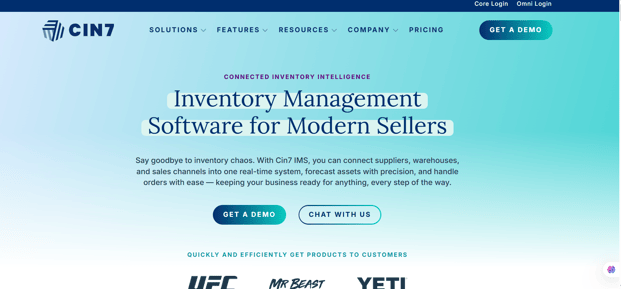
Cin7 is a comprehensive inventory management system (IMS) built for product businesses that have outgrown basic sync tools. Where Connex is primarily an order-to-accounting sync layer, Cin7 is a full operations platform covering purchasing, warehouse management, B2B sales, and multichannel order fulfillment.
Key Features
- Advanced multi-location inventory management with real-time stock tracking across multiple warehouses and fulfillment locations
- B2B portal with customer-specific pricing, purchase order automation, and supplier management
- Integrations with Shopify, Amazon, eBay, and major 3PLs for multichannel order fulfillment
- Built-in reporting on COGS, gross margin, inventory turnover, and channel-level profitability
- EDI capabilities for retail compliance with large retail partners
Best For
Mid-market product brands, wholesalers, and distributors that need a full inventory management system; not just an accounting sync layer. Businesses with complex purchasing, warehouse, and B2B workflows.
Limitations
Cin7 is priced and scoped for mid-market and enterprise use. For businesses whose primary need is accounting sync and ecommerce automation (as opposed to full inventory management), Cin7 may be better suited for businesses needing advanced inventory operations.
Pricing
Starts at approximately $349/month for the standard plan. Enterprise pricing is custom.
5. Zoho Inventory
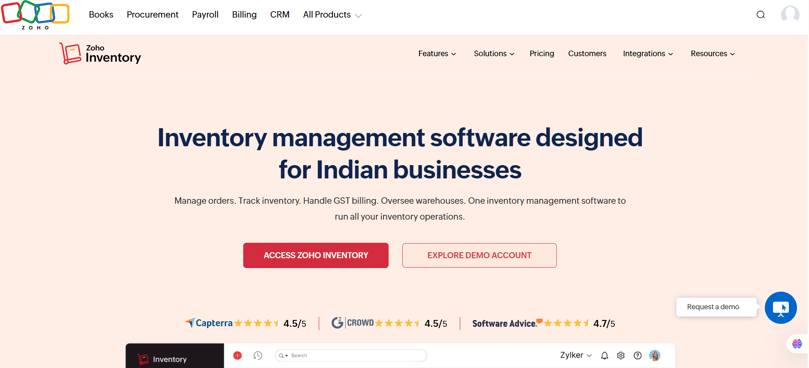
Zoho Inventory is a beginner-friendly inventory and order management platform that connects multiple sales channels and integrates natively with both Zoho Books and QuickBooks Online. For budget-conscious ecommerce SMBs that want more than basic sync but are not ready for enterprise pricing, Zoho Inventory offers a capable middle ground.
Key Features
- Multichannel order management connecting Amazon, Shopify, eBay, and Etsy in one dashboard
- Inventory tracking with batch tracking, serial number tracking, and low-stock alerts
- Purchase order creation, vendor management, and basic warehouse management
- Native integration with Zoho Books for end-to-end accounting within the Zoho ecosystem, plus QuickBooks Online sync
- Shipping integrations with UPS, FedEx, USPS, and DHL
Best For
Small to mid-sized ecommerce businesses that want affordable multichannel inventory management and basic accounting integration without the complexity or cost of enterprise platforms.
Limitations
Zoho Inventory's reporting and workflow customization are more limited than Webgility or Cin7. Businesses scaling to multiple warehouses, high SKU counts, or advanced financial reporting, may find Zoho's ceiling relatively low.
Pricing
Starts at $39/month (Standard plan). Free plan available for very low-volume businesses (up to 50 orders/month).
6. Extensiv
Extensiv (formerly 3PL Central) occupies a very different space from the other tools on this list. Where most Connex alternatives are designed to help ecommerce sellers manage accounting and inventory, Extensiv is purpose-built for third-party logistics providers and enterprise brands with complex warehouse and fulfillment infrastructure.
Key Features
- Full warehouse management system (WMS) with pick, pack, and ship workflow automation
- 3PL client billing, storage billing, and client-facing portal for visibility
- Integrations with Shopify, Amazon, EDI partners, and major shipping carriers
- Order routing, kitting, assembly management, and lot/serial tracking
- Real-time inventory visibility across multiple warehouse locations
Best For
Third-party logistics providers and large-scale ecommerce brands with complex warehouse operations, multi-client fulfillment needs, or retail compliance requirements.
Limitations
Extensiv is not suited for smaller sellers or businesses looking for a Connex-style accounting sync replacement. It is an enterprise warehouse management platform with pricing and complexity to match. It does not provide built-in ecommerce accounting automation compared to other platforms.
Pricing
Custom pricing: contact Extensiv’s team for a quote.
How to choose the right Connex alternative
The right Connex alternative depends on the specific gaps in your current setup. Here is a practical decision framework:
|
If you need… |
Best choice |
|
Guaranteed reconciled books and ecommerce operational visibility |
Webgility |
|
Just accounting software with apps available for ecommerce sync |
QuickBooks Online |
|
WooCommerce-only QuickBooks sync |
MyWorks Sync |
|
Full inventory control for a product-based business |
Cin7 |
|
Affordable inventory and order management |
Zoho Inventory |
|
3PL or enterprise warehouse management |
Extensiv |
Most growing ecommerce brands, especially those managing two or more sales channels alongside QuickBooks ultimately choose Webgility because it is the only platform on this list that guarantees always-reconciled books, not just synced ones.
|
Success story: Real-World Win: From $1.9M to $5.5M in Revenue Bases Loaded, an online sporting goods retailer, hit a wall with manual data entry as orders scaled. After switching to Webgility, they grew from $1.9M to $5.5M in revenue and now process over 10,000 orders a month, without adding headcount. As owner Dan Wells put it: "You cannot truly scale any online business without Webgility's automation." |
Rather than relying on a sync connector, a separate inventory app, and a reporting dashboard to work together, Webgility brings these functions into a single platform, continuously reconciling financial data and supporting a faster, more accurate month-end close.
Ready to see the difference? Talk to our experts to see how Webgility gives you books you can trust, not just books that closed.
FAQs
What is the best Connex alternative?
Webgility is one of the best Connex alternatives for growing ecommerce businesses because it combines accounting automation, inventory management, and multichannel operations in one platform.
Which Connex alternative works best with QuickBooks?
Webgility, MyWorks Sync, and QB Online itself are strong options depending on your business complexity and sales channels.
Which Connex competitor is best for inventory management?
Cin7 is best for advanced inventory management, while Webgility provides a balanced mix of inventory, accounting, and operational automation.
 Nikita Sikri


%20(1).jpg?width=24&height=24&name=IMG_9737%20(2)%20(1).jpg) Nikita Sikri
Nikita Sikri


 Nikita Sikri